Closed-loop depth holding
A working prototype has held a commanded depth in water using onboard feedback and control.
Buoyancy control & sensing · In development
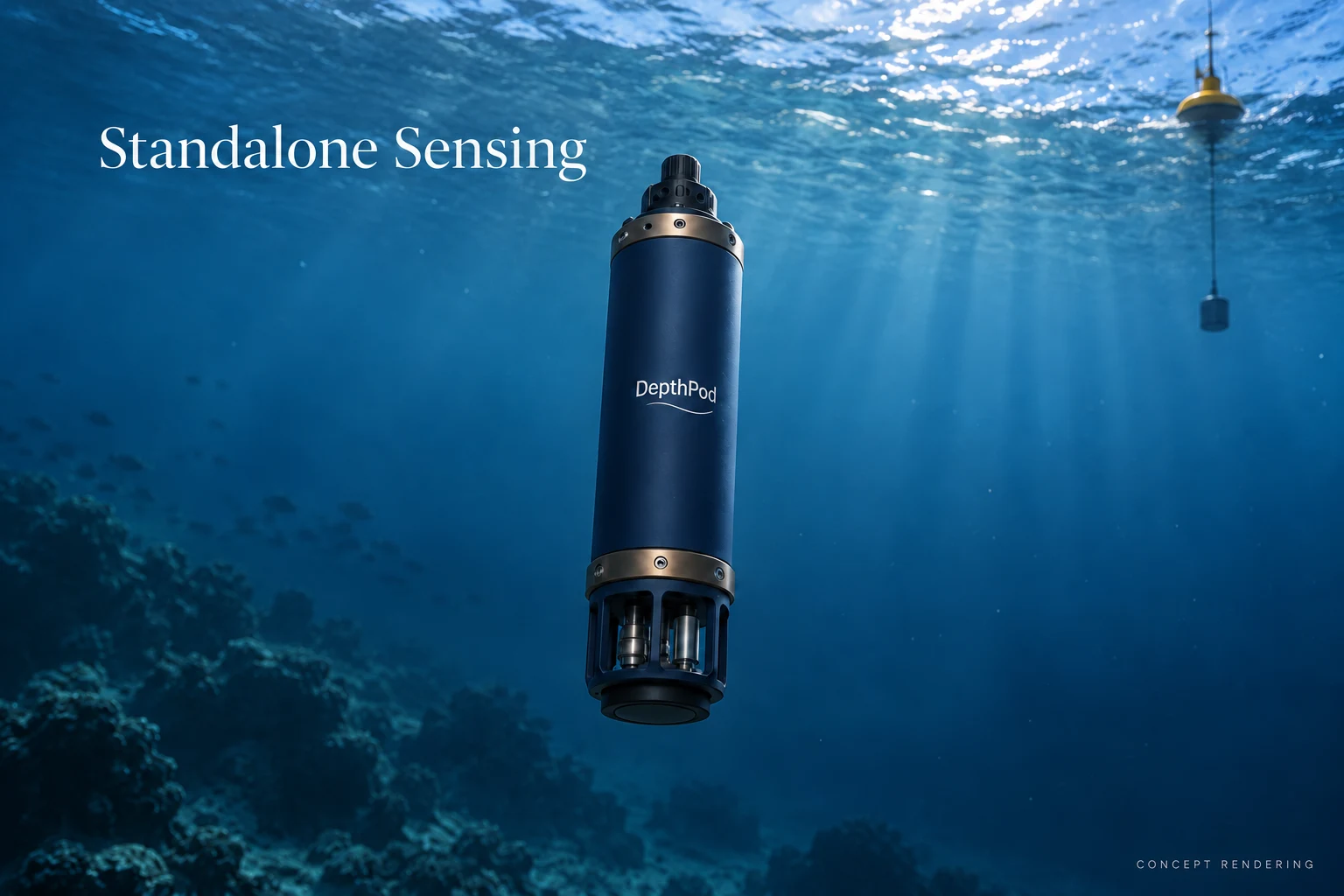
A modular buoyancy-control platform for underwater sensing and vehicle integration. DepthPod provides energy-efficient vertical maneuverability and commanded depth holding, with mission-specific sensors and configurable data links.
Design-depth target
Up to · Modeled depth holding
Modeled buoyancy range
Closed-loop depth holding in laboratory water testing.
Modular buoyancy control
DepthPod varies buoyancy to control vertical motion and hold a depth setpoint. An onboard pressure sensor provides feedback to the controller, keeping the depth-control loop within the module.
For a host vehicle, the interface supplies the commanded depth. The module does not require a continuous depth-measurement stream from the host.
A working prototype has held a commanded depth in water using onboard feedback and control.
Development targets include controlled depth changes, sustained depth holding and surfacing for data reporting or recovery.
Mounting, power and command interfaces can be tailored to a host vehicle or standalone sensing mission.
Application configurations
Standalone sensing and vehicle integration share the same buoyancy-control foundation. Payload and communications options are selected around the mission.
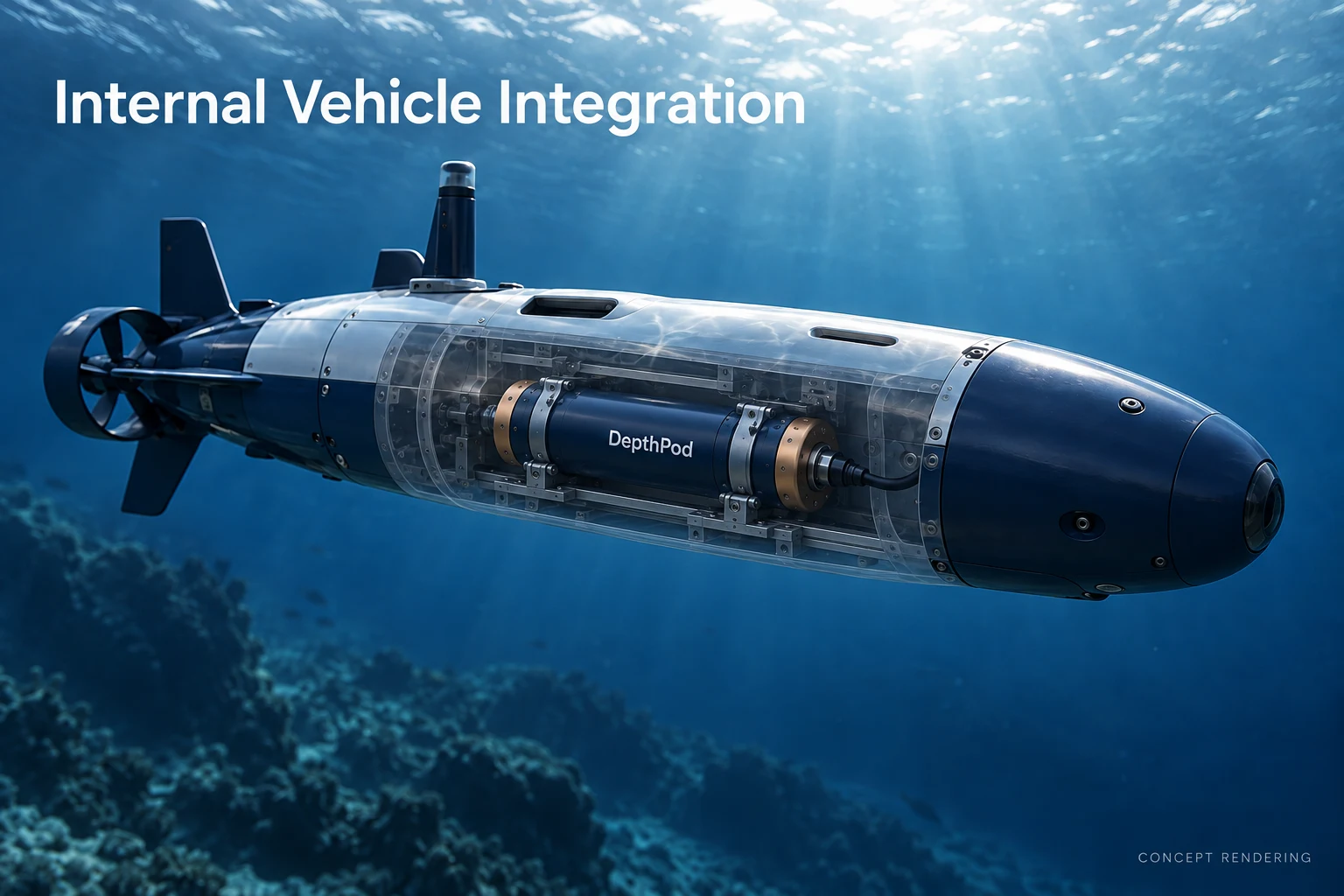
Integrate buoyancy and depth control within a UUV’s hull. The host commands depth setpoints while DepthPod manages its own feedback loop.
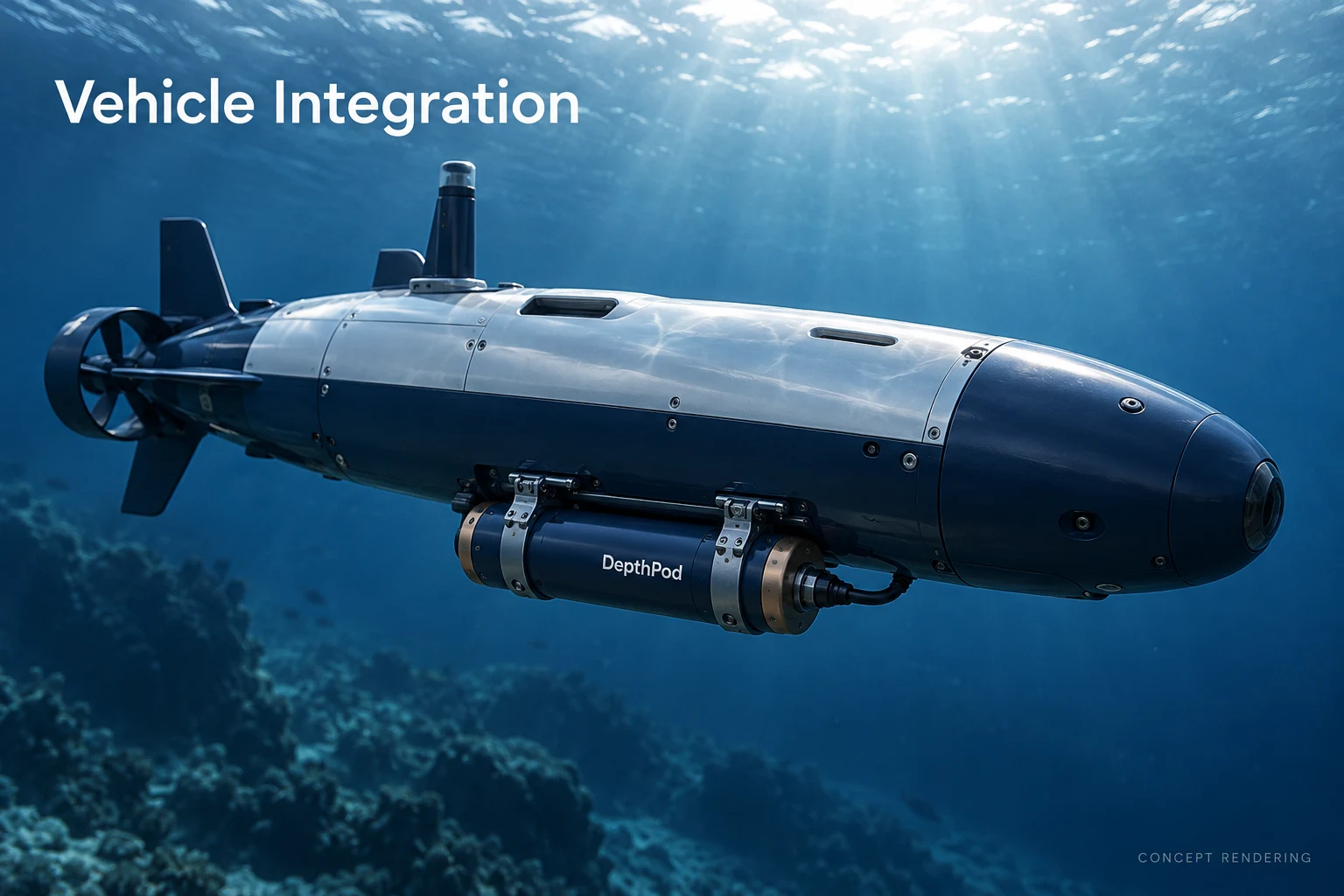
Add a dedicated buoyancy-control payload to a vehicle, with mechanical, electrical and data interfaces adapted to the installation.
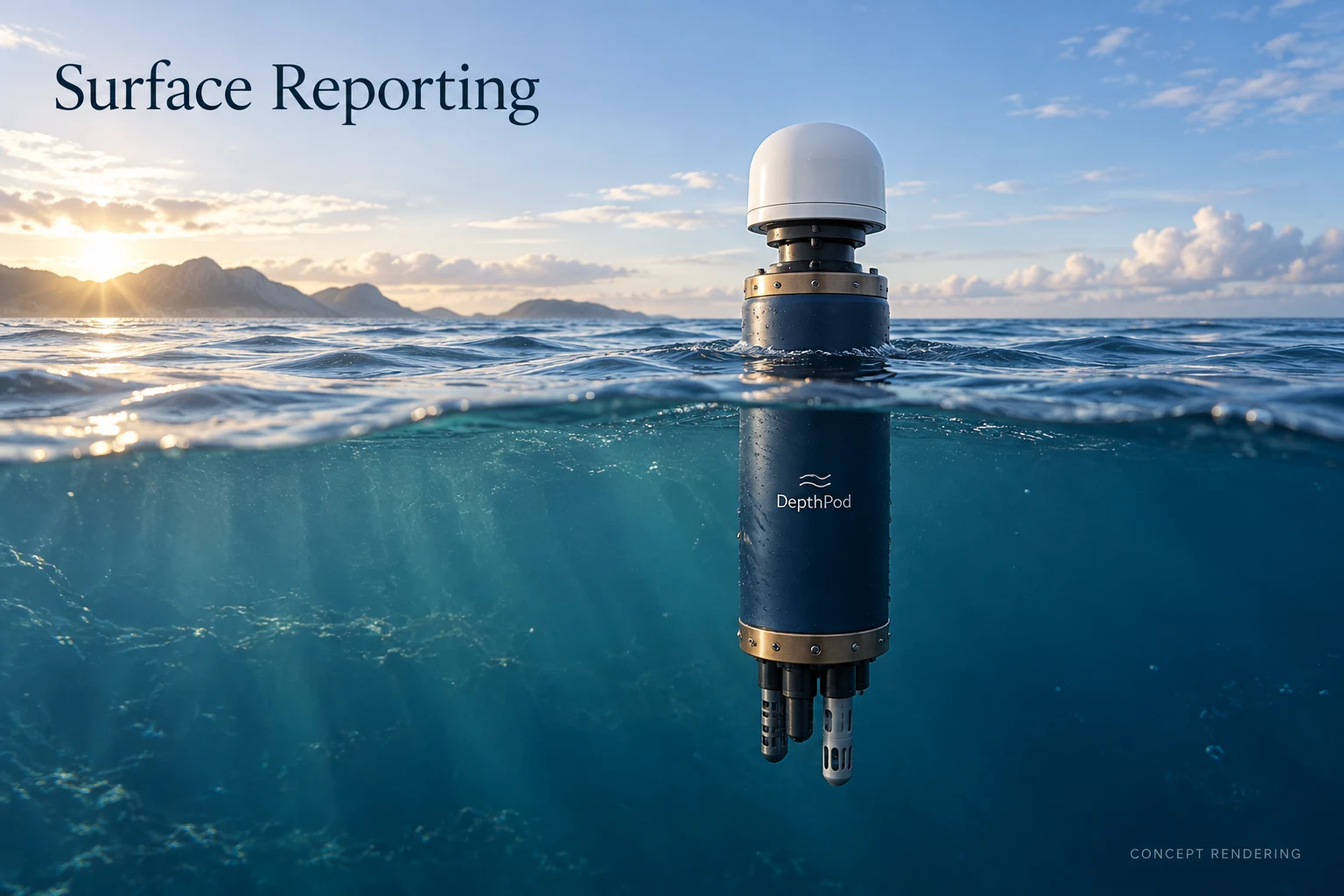
Carry sensors to a target depth, collect data and report through an acoustic modem underwater or a satellite link at the surface.
Payload options include hydrophones, conductivity-temperature-depth (CTD) instruments, water-quality and chemical sensors, and magnetometers.
Communications options include acoustic modems underwater and satellite links above water. GPS supports surface position fixes and position reporting for tracking and recovery.
Application views illustrate proposed configurations. Sensor, communications and positioning integrations are options for development, not demonstrated payload qualifications.
Hardware & model validation
Laboratory testing establishes the prototype’s behavior. A high-fidelity Simulink/Simscape model supports evaluation of depth response and larger buoyancy configurations.
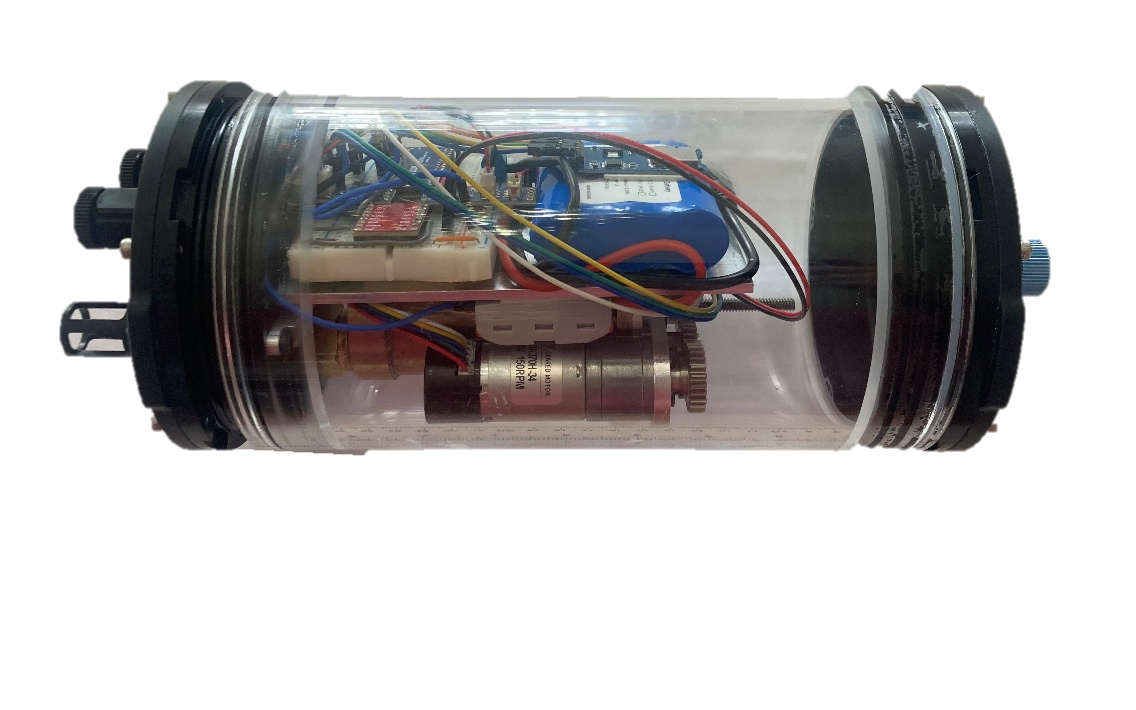
The prototype has demonstrated closed-loop depth holding in water. Measured test data have been used to validate the model within the tested conditions.
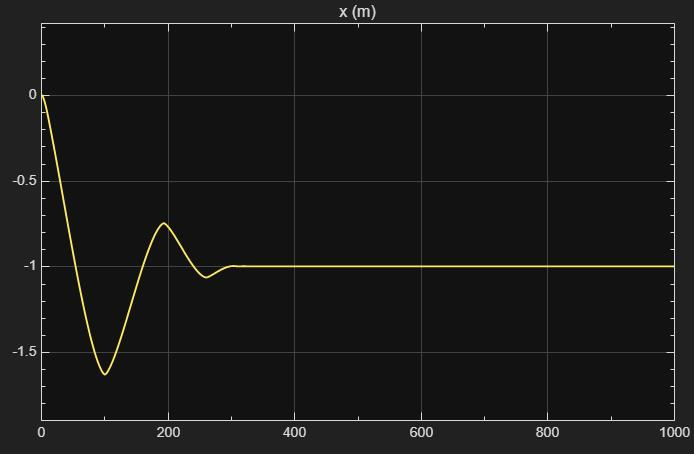
The model uses the prototype’s PI control parameters, backlash and piston speed. Measured traces agree with model predictions; the model has also been extended to explore buoyancy control up to 40 N.
The plotted response is a simulation. Larger buoyancy configurations, two-week endurance and the 1,000 m design-depth target have not been demonstrated by the laboratory prototype.
Preliminary specifications
Buoyancy authority scales with controllable water volume. The ranges below describe the modeled portfolio and intended architecture, rather than a single qualified configuration.
| Parameter | Value | Basis |
|---|---|---|
| Buoyancy-control range | ±4 to ±40 N | Modeled configuration range |
| Package volume | 1.5–16 L | Modeled configuration range |
| Operating depth | Up to 1,000 m | Design target; configuration dependent |
| Endurance | Up to two weeks | Modeled for constant-depth holding |
| Depth feedback | Onboard pressure sensor | Self-contained control architecture |
| Host command | Depth setpoint | No host depth-measurement stream required |
Endurance is modeled for constant-depth holding. Repeated depth changes consume additional energy and gas and reduce endurance. Payload demand, battery capacity, gas supply and duty cycle affect mission duration. The depth target requires suitable pressure-rated hardware and gas supply; depth qualification remains future work.
Discuss Your Application
Share your target depth, buoyancy range, payload, hold duration, depth-change schedule and integration constraints. We can discuss a standalone platform or a vehicle-integrated configuration.
Discuss Your Applicationinfo@hiddengradient.co